Monday, 8 July 2013

The Loire Valley


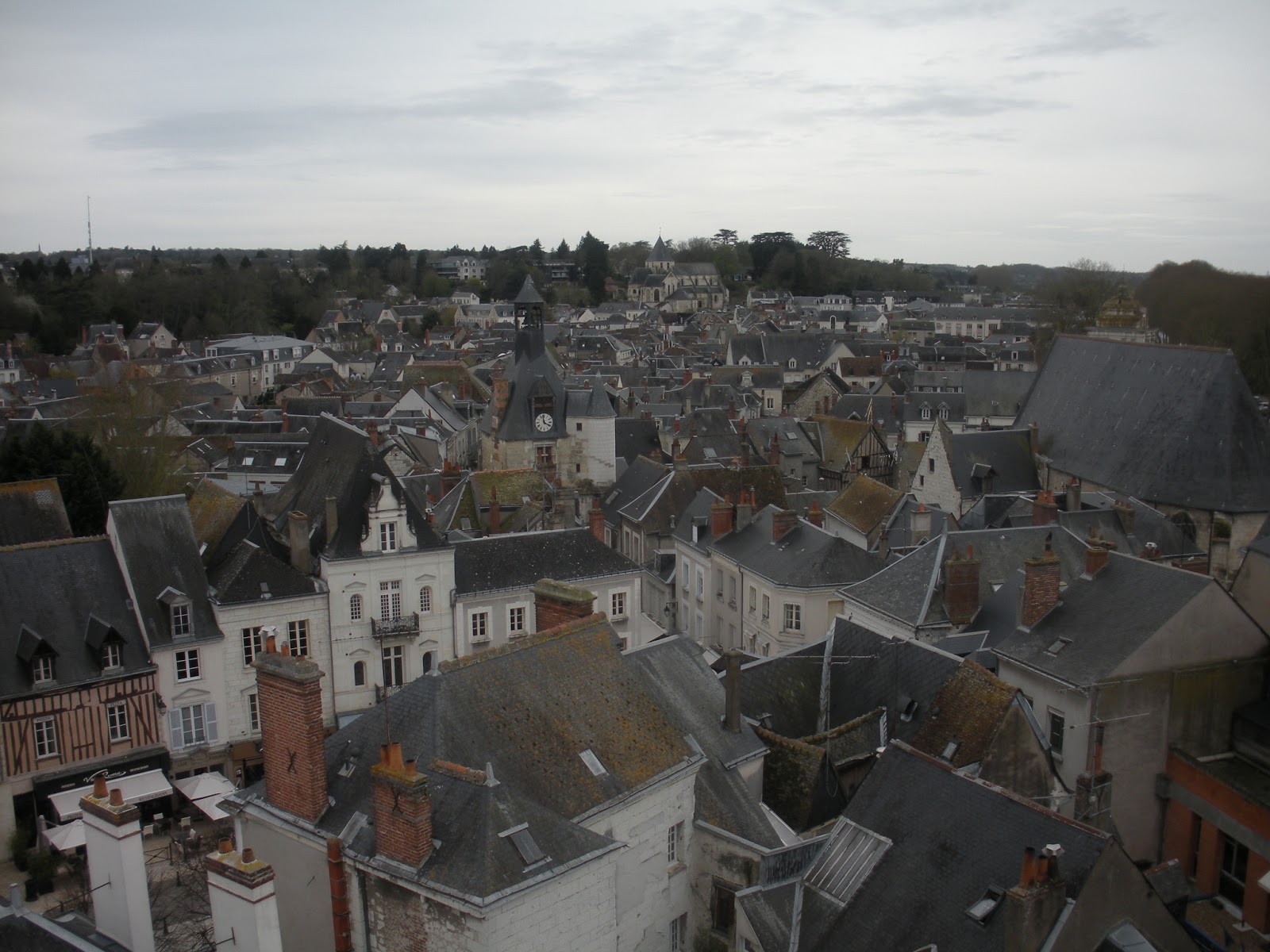
From Paris, we took the train to Amboise, on the banks of the Loire, whose valley is home to hundreds of chateaux.  

Part of the chateau at Amboise


This hall had a real, live fire to heat it.  At first this seemed strange to us - an open flame in a historical building?  But it does make a fair bit of sense - there have been fires in these buildings for hundreds of years, after all.

While in Amboise, we also visited Clos Luce, a large house and walled garden where Leonardo da Vinci spent his last years at the invitation of French king Francis I.


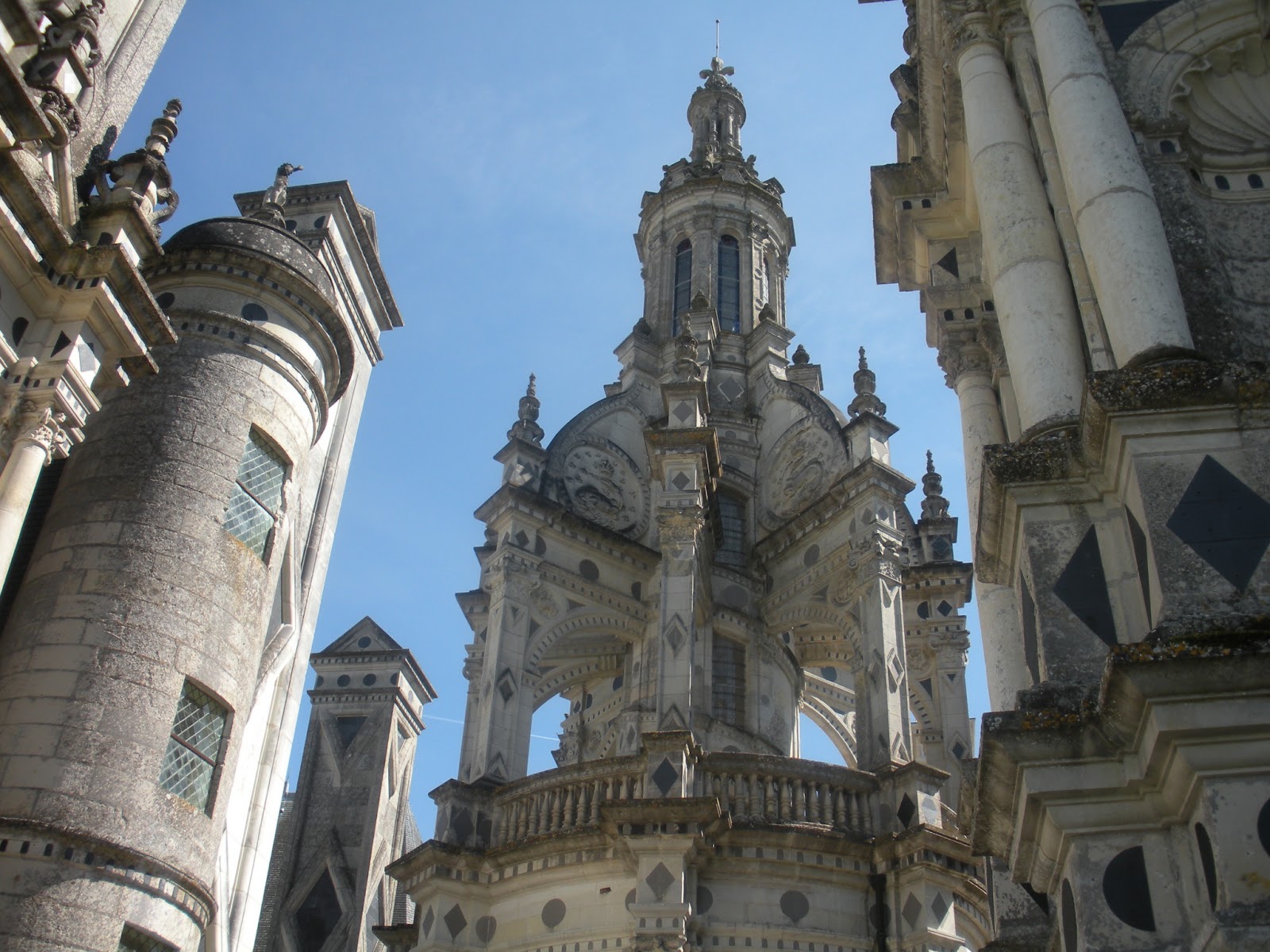
On our second day in the Loire Valley, we took a minibus tour to two of the biggest chateaux in the region.  Above was our first stop, Chambord, the largest chateau of them all and the first (or one of the first) to be built purely for hunting parties and, well, entertaining, rather than defense.


One of the highlights was this double helix spiral staircase.  There are two different sets of stairs which never meet.  Tim and I had fun each taking a side and catching glimpses of each other across the central well from the windows set into the staircase.


The fantastical, fairy tale-ish towers and turrets up on the terrace are also wonderful.

Chenonceau was next.  Looks smallish from the front, right?

The main chateau was given to a French king's wife for her use, but she was then replaced by the king's mistress, Diane de Poitiers, who had the chateau wing built across the river!


Here is the gallery which runs across the river.


And here is the kitchen, one of the best fitted out we've ever seen in a great house.

Then it was back to Paris in order to get on the TGV to Avignon!

Friday, 21 June 2013

Paris


Our first stop on our Easter vacation was Paris, which we had both visited four years ago.  So this trip was a good chance to visit new neighbourhoods and see sights we had missed the first time.  We stayed in a rental apartment right on the corner of L'Esplanade des Invalides (last time we stayed in the Marais).  Luckily for us, the first full day of our trip was the first nice day of spring (France apparently had a cold and rainy early spring, just like the UK).  It was lovely to walk around in the glorious sun and to watch the leaves coming out.  As we were right at Invalides, we visited Napoleon's Tomb (above), which is crazily grandiose, and also the military history museum attached, which is very good.


We took the metro to Montmarte to finally visit Sacre Coeur.  You can see the multitudes of people sitting on the hill, enjoying the sun.  The bit of Monmartre we saw was unfortunately rather touristy, not very bohemian anymore, alas.


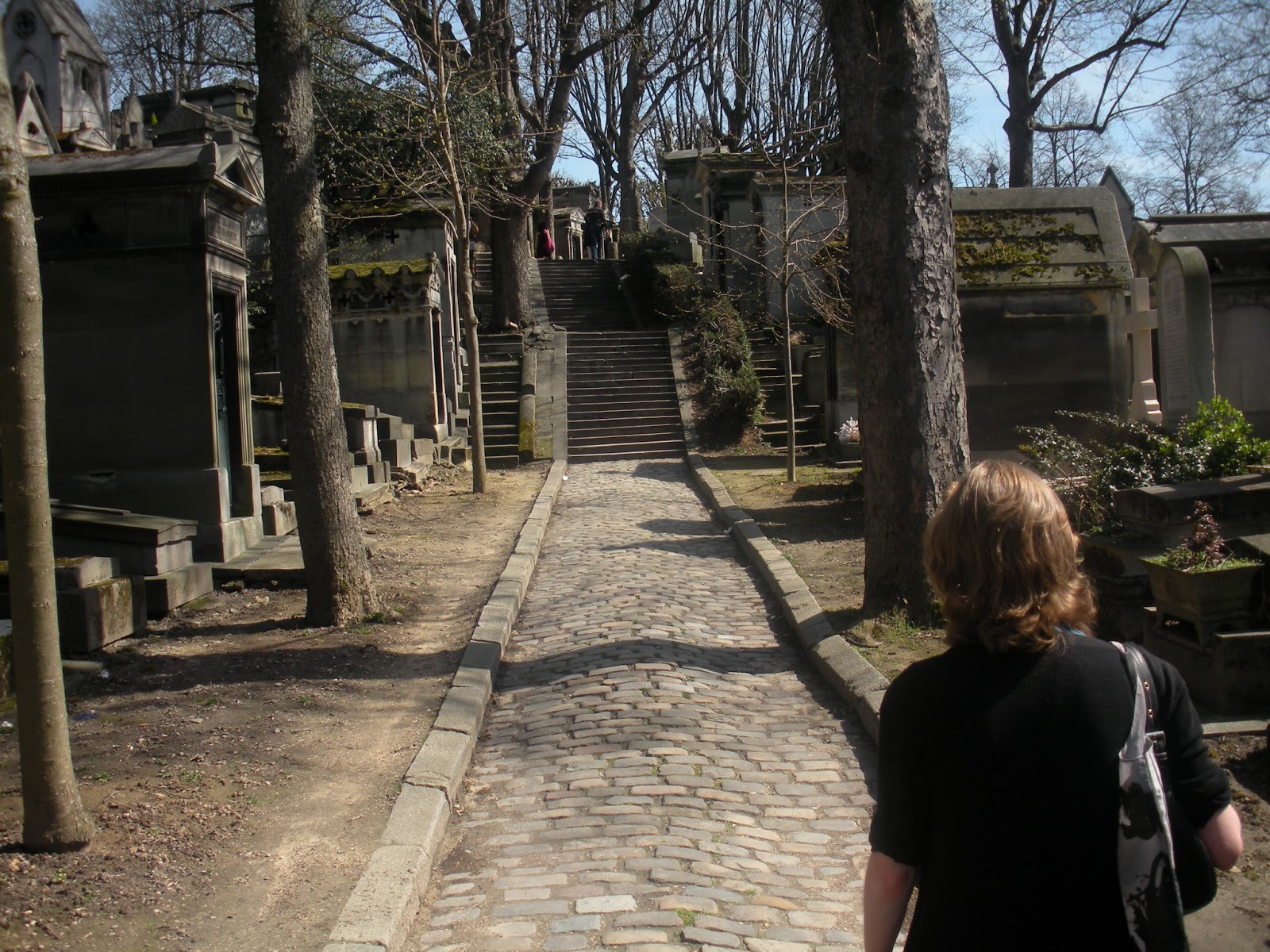
Then, onto the metro again to Pere Lachaise cemetary.  For some reason, I had been picturing a massive lawn covered with orderly tombstones, with a few monuments thrown in.  Oh, no.  Pere Lachaise is filled with family vaults of varying degrees of ornateness and delapidation.  There are proper paths (like the one pictured), plus innumerable little alleys between vaults.  Some vaults have lost their doors, or have had blocks fall out, or glass broken.  Where there are holes, part of me seized up with horror-film fear of what I would see if I looked over the edge - garbage, unfortunately.  The cemetary is huge, and well-treed, both peaceful and slightly eerie.  We meandered through a good portion of it, and ended with a visit to Oscar Wilde's grave.


Another day, we walked past the Palais Royale, to Place Vendome (pictured above), with its column made from melted down cannon from the Battle of Austerlitz (!).  We saw the Opera Garnier, but couldn't go in as it was closed (alas).  Then we revisited the Louvre.


One of my favourite parts was a courtyard that had been glassed over.  It was lovely to see the statues in natural light.  As I recall, we did a big loop home from the Louvre that day, crossing the two islands, visiting Notre Dame, winding through the Latin Quarter, taking a little break in Luxembourg Gardens, and then finally wending our way back to our apartment.  My feet were sore by the end!

Thursday, 20 June 2013

Blog Apologies and General Life Update


Hello!  I realised with some shame that it has been two months (ish) since I've updated this blog!  Partly it's because I've been busy, and then because I wasn't sure I had anything to say.  So, I've decided to break the ice with a quick update on the Easter vacation and Trinity Term have been like for me.

In the last two months, I've...
  • Gone to Paris, the Loire Valley, and Avignon on vacation (see obligatory Eiffel Tower photo above - with more pictures to come!)
  • Finished another section of my thesis, this time discussing domestic violence and other forms of male dominance in the Bronte novels.  Next up is a short section on male relationships (primarily on how they can be damaging when they impinge on domestic/family life).
  • Read many books for fun, including some that I plan to review on the blog in the near future.
  • Given the Michael Mahoney Graduate Seminar at my college - a one-hour lecture on my research, which was actually really fun, especially as it was followed by a fancy dinner in the chapel (which is currently serving as our dining hall).
  • Completely rewrote the end of my novel for the first time.  The ending is different from what I originally intended, but it fits better with my expectations for and conception of the book now.  I hope to start submitting it really, really soon - after one more proofread and a couple small changes.
  • Helped to organise this year's Oxford English graduate conference, "Object", which went really, really well.  I chaired a fantastic panel on Victorian material culture; there was an fabulous panel discussion on the Book as Object, featuring Nick Cross, Digital Products Manager at the Oxford University Press and fellow SCWBI member, Paul Nash, the University's printing tutor, and Stephen Walter, text/map artist.  The day was capped off by a fantastic keynote address on the construction of the author as "object" by acclaimed children's author Frances Hardinge.  (Her most recent novel, A Face Like Glass is amazing and Frances is absolutely lovely in person to boot!)
  • Went up to London to see The Book of Mormon (amazing, with brilliant music, and much blasphemy - not for the easily offended) and finally visit the Tate Modern (loved the first floor Surrealists, then became increasingly bored by the abstract art and installations - I am a bit of a traditionalist, I suppose)
  • More recently, went up to London to see Neil Gaiman talk about his most recent novel, The Ocean at the End of the Lane.  Amazing.  Also snagged a signed first edition, which is very good so far.
  • Plus, I attended the seminars for the Developing Teaching and Learning course run by the Humanities Division and am working on a teaching portfolio to submit in hopes it will gain me Associate Fellow status with the Higher Education Academy.  As part of my teaching training, I ran revision classes and tutorials to prepare first-year Mansfielders for their exam on Victorian literature, which was a rewarding experience.  It was great to really dig into the Victorians with friendly, enthusiastic, and hard-working students.
Okay, I think that's it.  I will try to update more frequently, and will definitely post pictures from our France trip.  The next big thing is that we're going home for two weeks on Saturday, which is shockingly only two sleeps away!  Yikes.

Thursday, 4 April 2013

Tales from the DPhil, Part Two: Writing the Thesis Like a Novel

Welcome to Part Two of this upstart series, Tales from the DPhil.  Today is the juicy stuff - writing tips!

Last term, I discovered that the single biggest stress- and anxiety-causing aspect of my doctoral experience was my approach to writing the darned thing.

In undergrad and my Master's, I did quite well writing essays by researching a lot up front, creating detailed outlines, and then racing through a draft with a quick polish at the end.  Because I always had hard deadlines, I always made them, even if this required some crazy writing days.

This is by no means an ideal writing strategy for a doctoral thesis.  A term paper can (but probably shouldn't) be a sprint.  A thesis is a marathon.  A three-year marathon.  A thesis also demands consideration, the evolution and testing of ideas and arguments, the honing of sentences.  I was trying to write chapters in big bursts (which didn't work) and then had no time for proper revision.  I became anxious about writing and avoided it.

So, I decided I had to make writing much less daunting.  I decided to write my thesis as if it were a novelI'm quite proud of this revelation.

I've been writing novelish fiction since I was fourteen.  I know how to write a big, multi-part project and just needed to apply the same strategies to my thesis.  I know from experience that I need to write every day, preferably to a very manageable word goal.

Principles that Have Vastly Improved My Thesis-Writing Experience

1.  Come up with a manageable word count and stick to it every day.  I've chosen 500 words, which I think is approximately an hour's writing, but it varies a lot.  It amounts to 2ish sides of A4 or about 3-4 pages in my Moleskine journal or 2-3 paragraphs.  It is extremely doable and non-threatening because it seems like so little.  Also, the more regularly you write, the more natural it becomes.  As a bonus, on the days I force myself to write, I usually end up over-shooting this word goal and write closer to 600 words.  But no matter what, something is better than nothing.  Progress is better than standing still.  And, if you write 500 words a day for one work week, you suddenly have 2500 words.  That's almost a conference paper.

2.  Write first thing every day.  Because I know that if I put off my writing, it probably won't get done and I likely will not get much research done either, out of a general sense of anxiety and procrastination.  Also, writing is always the hardest part of my day.  Everything after it seems easier and more enjoyable.  And, once you've met your word count for the day, you've met a mini-goal, which feels great.  Plus, you don't have to worry about writing any more until the next day.

3.  Don't start with a blank page.  What I've been doing is writing longhand rough words one day and then revising while typing them the next.  This allows me to a do a first pass of revision and gets my writing brain working before I have to tackle fresh writing, which in turns makes tackling the new words less frightening.  In an ideal world, I would also take notes and write down ideas for the next day's rough words - that can be a big help to getting started.

4.  Don't worry if the words are rough/awful.  Once you have words, you can fix them!  If you don't have any words to play with, you can't do anything at all.  It's taken me a long time to come around to revising my academic and creative writing and to find strategies to help me do it.  Sometimes having a pile of messy, meandering words is a gift because it's often so easy to see how they could be improved.  A nicely proofread piece of work can be harder to take apart and put back together again because of its shiny surface.

5.  Realise that words/writing time are not an end but a process.  This is another realisation that made me feel better about my messy, daily words.  I'm not writing just to meet a word count - I'm writing because writing allows me to think through the issues I'm dealing with in a way that research or even outlining can't.  Sometimes I have little revelations while writing.  I realise what my argument is, or discover something new about a text.  I've realised that I need to spend a good portion of every day interacting with my words on the page, whether writing or revising.  If you leave a project for a few days, it's much harder to get back into it and pick up the flow of ideas again.  (Noveling is the exact same in this regard).

I hope these principles might be helpful to any grad school brethren who may be reading this.  Do you have any tips in turn?  (They are always much appreciated - it's very easy to slack off when it comes to writing discipline.)

Wednesday, 3 April 2013

Tales from the DPhil, Part One: Tips for Better Living and Working

Hello blog,

Last term, I somehow made the leap from Second-Year Slump levels of motivation and high levels of procrastination, stress, and anxiety (chiefly centred on writing) to high levels of motivation and writing.  Hence, I thought I'd write a bit about the life, working, and writing strategies that helped me out in the hope that perhaps they might help you, too.

This is Part One: Living and Working.  Tomorrow: Part Two: Writing the Thesis Like a Novel.


1.  Get a good night's sleep.  I suffered from some terribly off-kilter sleeping patterns over the Christmas vacation.  There were a few mornings I didn't get to sleep until 7 am.  This was not good for my productivity.

When I finally forced myself to wake up at 6:45 am, I discovered I was much more productive.  The days seemed so full of possibilities and I really got excited about tackling my work.  It's much better to find yourself at lunchtime with a few hours' of work under your belt than to have nothing at all.  Also, I quite like working on my novel over breakfast and coffee for my first working hour of the day.  This allows me to dedicate time to my novel revisions without feeling like I'm stealing time from my thesis.  If I put the novel off, I know I probably won't work on it later in the day.

2.  Find or create the conditions that will allow you to be productive.  I've realised over the past year or so that working at home isn't actually the best for me.  There are so many possibilities for distraction.  The internet.  The dishes.  A nap?  Last term, I discovered three ways to make my working day much more productive.

a)  I solved the internet problem (mostly) by using the Firefox add-on Leechblock, in which you can list the URLs of sites that you know you waste time on and block yourself from accessing them at certain times.  At the moment, I'm not allowing myself access to any social media, the Guardian website, YouTube, or my favourite blogs between 8:30 am and 5:30 pm on week days.  I've also prevented myself from accessing the settings in a way which I don't (yet) know how to disable.  (I could, of course, still go on Twitter on Tim's computer or my phone, but that would require more effort.)

b)  I found a great place at school to work.  The English Faculty has a newish graduate work space which is perfect - just tables in a light, bright room and an almost non-existent wireless signal.  Also, often other graduate students are working in there, which allows for much needed human interaction.  And, because it is purely a space in which to do work, my perception of my work day is much different.  At home, it can be a struggle to log the hours I'm aiming for, especially with the temptation to take breaks or a nap.  At school, however, I can be happy working away for hours with minimal breaks because that's precisely what I'm there to do.  I don't even watch the clock that much.  I work until 5:30 or 6 and then I go home.

c)  I can do this because this is a space I can work in while snacking.  I used to work at home more because I wanted access to food and drink (there is no eating in Oxford libraries).  I can snack away or eat lunch in this work room, however, and it's changed my working experience hugely.  Before, if I sat down to work in a library, I would often almost instantly become hungry, which was incredibly distracting.  I've cut many a work day short in order to go home to eat something. Not a problem when I can eat while working.

3.  Allow yourself guilt-free time off.  When I was struggling (and failing) to meet the hours quota I set myself each day/week, I felt like I was always potentially supposed to be working (unless I was on an actual vacation).  This is stressful!  You (and I) need breaks that don't involve the thesis perpetually nudging your subconscious.  Since Tim has a regular, full-time job now, I also felt it would be really nice if I also had (mostly) work-free evenings and weekend.  After a vacation slump (due to the disappearance of the term schedule), I'm back to full productivity levels, which means that I can actually have evenings to myself, guilt-free.  (Confession: sometimes I'll have half an hour or hour of work to do, but since that often involves reading Victorian novels, that's fine).  It's actually strange not to need to work.  I find I don't quite know what to do with myself.

Tomorrow, I will share with you the secret of Writing the Thesis Like a Novel.  It involves word counts.  And happier thesis writing and revision.

Reader, if you are in a commenting mood, how, when, and where do you best work?

Tuesday, 19 March 2013

Going to Liverpool!, or Neo-Victorian Cultures: The Victorians Today

Hello, sad, neglected blog.  Today I have a revivifying post full of good news.

I found out a few days ago that I'll be giving a conference paper at the Neo-Victorian Culture: The Victorians Today conference running from 24-26 July at Liverpool John Moores University.  This is exciting because 1) I've never been to Liverpool and 2) I'll get to talk all about Alison Croggon's novel Black Spring, Wuthering Heights, adaptation, fantasy, and feminism!

I reviewed Black Spring here - well worth a read for Bronte fans and fantasy lovers.

In the draft programme, I see I've been placed on a panel called "Fantasizing the Victorians"; one of the other panelists is going to be talking about Terry Pratchett's Discworld.  Clearly this is going to be a great experience.

In other news, I had a really productive Hilary Term after a de-motivated and quite stressful Michaelmas and I think I'll write about some of the strategies I used that I found helpful in the next bit.  Now that the vacation has hit, I'm struggling to get some of my research and writerly get-up-and-go back, but I hope to blog soon on academic matters.  (PS - I also decided to completely restructure my thesis last term - very exciting!)

And in other, other news, Tim and I are heading off to France for a bit over a week in April.  I'm deep in the midst of booking places to stay and figuring out transport, but we're hoping to stay in Paris, Amboise (in the Loire Valley), and Avignon.

Monday, 4 February 2013

Review: LONG LANKIN, by Lindsey Barraclough

Long Lankin is a fantastic, post-war Britain ghost story, with undercurrents of M.R. James-style horror.

Gosh, sounds a bit like description of wine.

In some ways, Long Lankin in an atypical YA novel.  First of all, two of the novel's narrators are twelve (maybe thirteen), which would suggest the novel is middle-grade (ie: for ages 9-12).  However, the third narrator is probably somewhere near sixty, which suggests this isn't a novel for young people at all.  Also, the narrative includes largeish sections of archaic documents, with suitably old-fashioned language and spelling and stories of adultery, etc.  The novel is, however, an atmospheric, suspenseful YA read, driven by a great story.  All these non-standard elements make it original and also, perhaps, appeal to readers of all ages.

On to the story!  Cora and her four-year-old sister Mimi are sent from their East London flat in 1958 to stay with their Aunt Ida in her crumbling ancestral home in the Essex marshes.  While there, they befriend Roger and his family and set out to solve the mystery of why strange ghostly children appear in the nearby churchyard and why all the windows and doors of Guerdon Hall must be kept shut and locked at all times.  It soon becomes clear that Mimi, Cora's little sister, is in grave danger.

All three points of view are well drawn and Aunt Ida's is just as interesting as the children's because she knows much more than she wants to say about the history of Guerdon Hall and the nearby church.

Interspersed with all this ghostliness are much less chilling elements of good old childhood fun - family life, making camps in the woods, riding bicycles, hanging out in an old pillar box left over from the war, running to the shop to get a sweet while one picks up Dettol or washing up powder for Mum.  I've seen some readers complain that the novel begins slowly but I savoured all these details of childhood and post-war Britain.  This is the era in which my parents were born and my grandparents lived, but I'm familiar with the narrative of boom and prosperity in North America.  For that reason, it was fascinating to see a world in which bomb damage in London still hadn't been cleared and one might have to run over to the pub to make a telephone call.  (It reminded me at times of BBC's Call the Midwife, which we are currently watching).  Also, as in Sarah Waters's The Little Stranger, the post-war period offers a good opportunity for both ghost stories and discussions of class and social change.

The slow build of atmosphere and the careful revelation of the story of Long Lankin are very effective in racheting up the suspense.  At one point I felt viscerally, physically tense, waiting to find out what would happen to the characters I had grown to care for.

This is a novel based on the ballad "Long Lankin", which is printed at the beginning of the book.  Knowing the ballad makes the novel more chilling but doesn't give the plot away.  Part of the fun of the novel is the way Barraclough works out elements of the ballad and places them in a sensible historical context.  This method reminded me of Janet McNaughton's An Earthly Knight, a YA retelling of the ballad of Tam Lin.

P.S.  I love the cover - the misty obscurity, the looming trees, and the girls who look like they're actually from the 1950s.  One of my pet peeves in the covers of historical novels are models who look much too modern!

Saturday, 2 February 2013

Review: A WORLD BETWEEN US, by Lydia Syson

In the last year, I've learned more about the Spanish Civil War from reading young adult novels than I ever learned in school.  First, I read Michelle Cooper's fabulous The Journals of Montmaray trilogy, which worked in details about the civil war through the characters' links to Spain and friendship with a Basque captain (reviews here and here).  Then, at the beginning of January I read - almost in one sitting - Lydia Syson's first novel for young adults, A World Between Us, which centres around a love triangle between a nurse, an International Brigades soldier, and a journalist, all fighting fascism in war-torn Spain.

Felix (short for Felicity) is a London nurse who follows Nat, a Jewish communist and International Brigades soldier to Spain, out of a sudden, head-over-heels love for him and deep need to escape middle-class, patriarchal suburban life and expectations.  George, a family friend who hopes to marry her, follows her when she disappears from the Gare du Nord in Paris and works as a journalist while he tries to discover information about her whereabouts.

Introducing these three point-of-view characters, explaining their motivations, and getting them to Spain takes a very few chapters at the beginning of the book, a tricky manoeuvre that felt slightly unwieldy and rushed to me.

But once they get to Spain, let me tell you, the novel really gets going.  This is the second novel I've read from Hot Key Books's inaugural year.  The clever wheel on the back of the book promises 50% epic romance, 25% history, and 25% drama.  I was a bit worried that the focus of the novel would be on the love triangle, to the exclusion of the fascinating and frankly, really important historical details of the Spanish Civil War, which was in many ways a training ground for the strategies and techniques used in World War II.  For instance, the bombing of civilian and not just military targets for the purposes of creating terror.  It began with the destruction of Guernica, so terribly evoked in Picasso's famous painting, and repeated itself with terrible consequences in the East End of London, Coventry, Hamburg, Dresden, and many other cities.

Picasso - Guernica
However, I need not have worried.  Syson does a wonderful job of melding historical detail with the lives and loves of her characters.  The brutality of the fighting, dealing with bombings, and tending the war-wounded are told compellingly, as is the psychological strain Felix, Nat, and George experience.  In a setting like this, the memory of love becomes precious, a place to escape to in a world on fire.  The lovers in this novel don't actually spend that much time together.  Each character develops over the course of the war and comes to his or her own understanding of the importance of the conflict they are engaged in.  These periods of separation also means that moments like the ones in which George sees Felix again or Felix is able to sit with Nat in war-weary Madrid carry heart-breaking significance.  Syson deals well with the physicality of romantic relationships in wartime - why wait if you might die tomorrow?  What do social expectations matter in world turned upside down?

As the novel progresses through the various stages of the civil war, helpful maps at the beginning of each section show the advance of Franco's troops and the major centres where the action takes place, so that you can see just how far away the characters are from each other at any given time and how close they are to the front line.

Felix's experiences as a nurse, sometimes in haphazard, ad hoc conditions, are especially well done.  As a Canadian, I was so pleased to see that one of our national heroes, Dr. Norman Bethune, has a walk-on role.  Shamefully, I had not realised that Bethune pioneered a system for blood transfusions at the front during the Spanish Civil War.  The details of blood types, the importance of refridgeration, and the sacrifice of the doctors and nurses who gave their own blood to save their patients are all skillfully rendered.

Syson also does an excellent job at hinting at the divisions and suspicions within the anti-fascist faction.  George Orwell went to Spain to serve, only to flee with his wife when the communists accused him of being a Trotskyite.  The author also illustrates the conflicts between the communists and the Catholic Church, showing the reader that the political, religious, and military situation in Spain was complex and multi-faceted.

As the novel drew to a close, I became so engaged with the characters that I found myself throwing out any aesthetic expectations of a balanced ending, only hoping for the characters' happiness in the face of tragedy and barriers at every turn.  I'm happy to say that the novel ends the right way (notice, I'm not saying how it ends, or what "right" means).  Any personal happiness the characters win at the end comes at the cost of their experiences in Spain and also the inescapable fact of failure and impotence.  If you know the history going in, you know that the Spanish communists and International Brigades were defeated and Franco governed Spain until his death in the 1970s.  What I hadn't realised until the Afterword is that the international volunteers were actually sent home in 1938, unable to fight until the bitter end.

And more problems waited for them at home.  International volunteers were seen as suspect because of their relationship with communism and some were not allowed to volunteer as soldiers in the Second World War because Western governments were concerned about their loyalty.  Some people had trouble gaining employment after returning from Spain.  Volunteers also weren't recognised as veterans until long after the conflict as well.

If you enjoyed Elizabeth Wein's Code Name Verity or Michelle Cooper's Montmaray books and are looking for another fabulous YA historical novel, I heartily recommend you pick up A World Between Us.

P.S.  Last year, a bunch of old interviews with Canadian volunteers in the Spanish Civil War were discovered in the basement of the CBC building in Toronto.  Material from these interviews featured on three episodes of the program Living Out Loud.  You can listen to them on CBC's player here.  Fascinating stuff.
Music of Michaelmas 2012: Within Temptation Edition

Before the end of last year, I promised a post on the music I listened to in Michaelmas Term.  Seeing as we are now three weeks into Hilary, I thought I'd better get this music post up now before it becomes morbidly too late.

Because I went to Within Temptation's fifteen-year anniversary concert in Antwerp, I spent some time listening to their back catalogue, Enter (1997), The Dance EP (1998), Mother Earth (2000), The Silent Force (2004), The Heart of Everything (2007), and The Unforgiving (2011).  In honour of this re-listening to one of my favourite-ever bands, I give, you my favourite six seven songs. 

(Which were incredibly hard to choose!)

"Candles", from Enter.  My favourite from the era of the first album and EP, when the band did "Beauty and the Beast"-style singing.  That is, pairing Sharon den Adel's lovely "clean" vocals with male, er, growling.  If you don't listen much music with growling, it will come across as strange and Cookie Monster-ish, but I've developed a bit of a fondness for it (in moderation!) and I quite like the contrast it creates in songs like this one.

Tuesday, 22 January 2013

Favourite Reads of 2012

I suppose this post is a bit belated, but at least it's still January.  Without further ado, I give you my "best of" list for 2012.  I've starred my five most favourite books in honour of their outstanding quality (Caveat: these were hard to pick and I may well change my mind in the future.)

(For my favourite books of 2011, click here.)

Published in 2012

Code Name Verity, Elizabeth Wein*

I bought my copy in February, pretty soon after publication, because the cover had attracted my notice in Blackwell's.  I think this may be my single favourite book of 2012 and perhaps the one I would most recommend.  You should read it because it's a fantastic YA historical fiction novel about espionage, flying, and female friendship in World War II.  This is an emotionally gripping, tighly written, and twisty turny novel that made me absolutely sob at the end.  Also, in recent years, I've become much less of a re-reader, but I think I may need to read this one again soon.  It's just that good.  I reviewed it here.  (YA historical fiction)