Showing posts with label Day-tripping. Show all posts

Monday, 23 December 2013

Bristol Day-Trip

Hello, hello, poor neglected blog!  Three months is a long time between posts, so now that I'm sort of on Christmas vacation, I will try to catch you up on my Michaelmas adventures - DPhil strategies that mostly seemed to work and trip pictures - as well as the standard end-of-the-year "Best Books" post (which I can't write yet because I'm still reading!) and goals for 2014 (namely: Submit Thesis).

The best way to slide back into blog posting is to share some pretty pictures, so I'll start with shots from our November anniversary day-trip to Bristol, which was great fun.


Upon arriving in Bristol, we headed to the furthest afield site we were interested in: the suspension bridge at Clifton, designed by good old Victorian engineer Isambard Kingdom Brunel.  (Actually, there's a bit of a Brunel theme to the whole trip.)  We walked across half the bridge.  Apparently there are great trails on the other side of the Avon gorge but we didn't have enough time to explore them.  Next time, perhaps.

We checked out the bridge from the hill the Clifton Observatory sits on.  As you can see, the observatory was all fenced off, so we couldn't explore inside.  Alas.


Then we headed down through Clifton to the harbour, passing delightful (and very expensive) row houses along the way.

We made a point of popping into one particular courtyard to see the blue plaque on the building where Thomas Beddoes had his Pneumatic Institute in the late eighteenth century.  Tim wrote his MA thesis on Beddoes, who was also a Clifton doctor.


Bristol's harbour was rather lovely and housed, in permanent dry dock, Brunel's S.S. Great Britain, which you can tour inside and out after a great deal of restoration work.  The ship was the first to combine an iron hull with a screw-driven propellor.  In the 1930s, it was scuttled off the coast of the Falkland islands, but in 1970 the ship was raised and floated back to Bristol, where it had originally been built and launched.  As you can see, the hull has taken quite a beating from being immersed in salt water for decades, so it is now kept in very dry conditions to keep the iron from rusting any quicker than it needs to.  The interior is set up to resemble the ship's days as an immigrant ship to Australia.

Bristol Cathedral.  We met a very friendly verger on the way in, whose wife was Canadian.  We knew he must be connected to Canada because it was Remembrance Day and he was wearing a Canadian poppy, rather than a British one, and had secured it using a little Canada flag label pin.

 This is Cabot Tower, a lovely Victorian folly, built to honour John Cabot, who set out to explore what is know Canada from Bristol.  We got a lovely, misty view of the city from the first viewing platform.  I'm glad we didn't go to the top of the tower, because the stairs we did climb made my knees rather unhappy as it was.
 Then we followed that up by going down the Christmas Steps, a nice shopping street, and came upon this medieval almshouse.
 We saw this bomb-damaged church on the way back to the train station.  Because of its harbour, Bristol was a prime target for Nazi bombs during the Second World War, making the fifth most heavily bombed city in the country.
And to end our Brunel-themed trip, here is the Brunel-designed train station.

We also very quickly popped into John Wesley's first-ever Methodist chapel, but I don't have a picture of it!  I will check with Tim to see if he took a photo on his phone.

Tuesday, 10 September 2013

A Day-Trip to Birmingham

 Back in August, basically on a whim, Tim and I took a day-trip up to Birmingham, a city neither of us had been much interested in previously, but we ended up having a fantastic time and will almost certainly need to go back again.  What I discovered almost immediately upon arrival is that Birmingham is filled with treasures for a Victorianist, filled with lovely red-brick buildings and, for instance, the above-pictured Great Western Arcade, built in 1875-76.
 The lovely interior.
 Then we went to Birmingham's cathedral, one of the smallest in England, but lovely to visit, especially because it features four huge stained glass windows by Edward Burne-Jones, the pre-Raphaelite painter.
Here you can see two of the windows.  They all featured a surprising amount of red, making them seem rather lurid.
 We were very impressed with the civic spaces and buildings surrounding the Town Hall, which looks like a classical temple and which we apparently didn't take a picture of (tsk, tsk).  I've forgotten what the first building pictured was, but the lower one is the Birmingham Museum and Art Gallery.  The museum is free and wonderful - sort of a smaller mix of the Victora & Albert Museum (furniture, ceramics, etc.) and the Tate Britain (many pre-Raphaelite paintings, which we somehow missed), plus some great local history.  The history of the city did a great job of covering the Enlightenment figures who lived in Birmingham (many of whom Tim studied for his MA) and the city's abolitionists.
 A statue of Joseph Priestly, who discovered oxygen and was a Unitarian minister.  He was unfortunately run out of town when a mob burned his house down.  He ended up in the United States.  Tim considered writing his thesis on him.

After the museum, we went to the Pen Museum in the Jewellery Quarter.  For quite awhile, Birmingham was the centre of both the jewellery trade and the steel pen trade.  The Pen Museum housed tons and tons of metal pen nibs (including giant ones for use on posters!), pen nib boxes, and the machinery used to punch and shape pen nibs, plus fountain pens and typewriters of varying vintages, which you could actually test out.  For years we kept Mom's old university typewriter in the basement and when I was little, I remember playing with it was fair bit, and getting frustrated with the keys would all jam together.  This was the first time I'd used a typewriter since Mom's ribbon ran out of ink - they even had ribbons with black and RED ink!  It was all very fun, but I came away very grateful for computers.  I can't imagine typing an essay - a thesis - a novel - on a typewriter!

If we'd had more time, we would have booked a tour of the Jewellery Quarter Museum as well, but instead we set off through the quarter on a hike up to Matthew Boulton's house, Soho House, where the Lunar Society met.  One the way, we passed buildings that were (are?) jewellery workshops.
 This is Soho House.  I have to say, it seemed very liveable to me for an eighteenth-century house.  They've even uncovered the remains of a hot air heating system Boulton rigged up for the house.

Boulton was quite the man.  The house originally abutted the land taken up by Boulton's ground-breaking Soho Manufactory (sadly, it's all suburbs now).  With James Watt, Boulton came up with a new version of the steam engine, which ended up in factories all over the country.  He also minted coins and lobbied for an assay office in Birmingham, which allowed for the growth of the silver trade in the city.  Plus, how can you not love a man who had a Fossilry in his house - that is, a room for storing fossils!
At the end of our day in Birmingham, we went down to Gas Street, a span of the Birmingham canal charmingly lined with restaurants and pubs.

If we ever go back to Birmingham, we'd also like to see the university campus, Winterbourne House and garden, Aston Hall, and the Birmingham back-to-backs, the last surviving court of houses in the city, but you have to book ahead, as they only allow tours of eight through at a time.

Thursday, 20 June 2013

Blog Apologies and General Life Update


Hello!  I realised with some shame that it has been two months (ish) since I've updated this blog!  Partly it's because I've been busy, and then because I wasn't sure I had anything to say.  So, I've decided to break the ice with a quick update on the Easter vacation and Trinity Term have been like for me.

In the last two months, I've...
  • Gone to Paris, the Loire Valley, and Avignon on vacation (see obligatory Eiffel Tower photo above - with more pictures to come!)
  • Finished another section of my thesis, this time discussing domestic violence and other forms of male dominance in the Bronte novels.  Next up is a short section on male relationships (primarily on how they can be damaging when they impinge on domestic/family life).
  • Read many books for fun, including some that I plan to review on the blog in the near future.
  • Given the Michael Mahoney Graduate Seminar at my college - a one-hour lecture on my research, which was actually really fun, especially as it was followed by a fancy dinner in the chapel (which is currently serving as our dining hall).
  • Completely rewrote the end of my novel for the first time.  The ending is different from what I originally intended, but it fits better with my expectations for and conception of the book now.  I hope to start submitting it really, really soon - after one more proofread and a couple small changes.
  • Helped to organise this year's Oxford English graduate conference, "Object", which went really, really well.  I chaired a fantastic panel on Victorian material culture; there was an fabulous panel discussion on the Book as Object, featuring Nick Cross, Digital Products Manager at the Oxford University Press and fellow SCWBI member, Paul Nash, the University's printing tutor, and Stephen Walter, text/map artist.  The day was capped off by a fantastic keynote address on the construction of the author as "object" by acclaimed children's author Frances Hardinge.  (Her most recent novel, A Face Like Glass is amazing and Frances is absolutely lovely in person to boot!)
  • Went up to London to see The Book of Mormon (amazing, with brilliant music, and much blasphemy - not for the easily offended) and finally visit the Tate Modern (loved the first floor Surrealists, then became increasingly bored by the abstract art and installations - I am a bit of a traditionalist, I suppose)
  • More recently, went up to London to see Neil Gaiman talk about his most recent novel, The Ocean at the End of the Lane.  Amazing.  Also snagged a signed first edition, which is very good so far.
  • Plus, I attended the seminars for the Developing Teaching and Learning course run by the Humanities Division and am working on a teaching portfolio to submit in hopes it will gain me Associate Fellow status with the Higher Education Academy.  As part of my teaching training, I ran revision classes and tutorials to prepare first-year Mansfielders for their exam on Victorian literature, which was a rewarding experience.  It was great to really dig into the Victorians with friendly, enthusiastic, and hard-working students.
Okay, I think that's it.  I will try to update more frequently, and will definitely post pictures from our France trip.  The next big thing is that we're going home for two weeks on Saturday, which is shockingly only two sleeps away!  Yikes.

Wednesday, 12 December 2012

Fun December Things: A List

  1. Mulled wine, my new favourite hot drink
  2. Seeing Florence + The Machine live in London
  3. Visiting Dr Johnson's house
  4. Seeing the new digital restoration of Lawrence of Arabia at the BFI (with an actual and much-needed intermission)
  5. Scottish country dancing at Tim's work Christmas party.  Very Jane Austen, while simultaneously being very Scottish.
  6. Snow before Christmas (unlike last year's snow in February)
  7. This morning's hoar frost-covered spider's web

Friday, 11 May 2012

Picture Post: Four Colleges and a Palace

Here are some pictures from the Easter vacation.  The end of March was very warm and summer-like, so Tim and I had an excellent excuse to go exploring Oxford and its college.  April, however, and frankly most of May so far, has been rather cool and rainy.  April was, in fact, that rainiest April since 1910, which is quite something.


 The ceiling of Pembroke College's chapel.

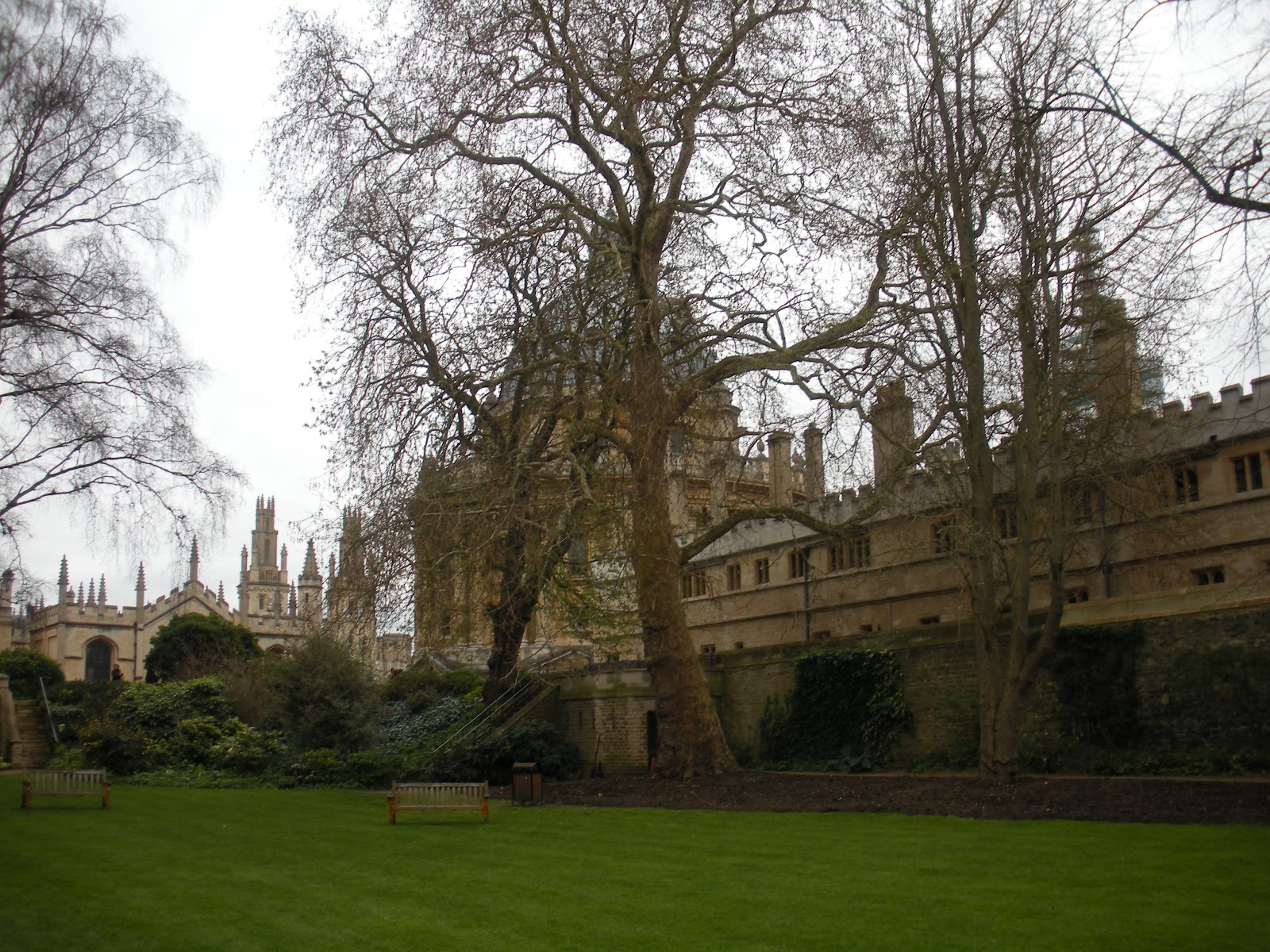
 The view of the Radcliffe Camera from the very grand quad at All Soul's College.  All Soul's is a graduate only college and you must be invited to become a member or become a member by writing a gruelling exam.  Yikes.

 The antechamber of Merton College's chapel.  J.R.R. Tolkien was a professor here for many years.  Also, Merton is very old (I think it was founded in the Medieval period) and has lovely gardens.

 Another view of the Radcliffe Camera, this time from Exeter's Fellows' Gardens.

I really must work in here sometime.  I've only ever popped in to take a very reverent look around.  I usually either work from home or read in the Upper Reading Room at the Old Bod.

And Blenheim Palace, which we visited with my parents.  It is the only non-royal residence in Britain to be called a "palace" (I think).  Its library, which is tremendously grand and boasts its own pipe organ, is apparently the second longest room in a private house in the UK.  Now I'm most curious to find out which house has a longer room.  Also, if you happen to visit and have the opportunity to tour the private apartments of the current Duke and Duchess of Marlborough, do so.  You'll get a much better idea of how the residents of this house actually lived, as the state apartments are only used on special occasions.  And, if you are a Winston Churchill fan (as we all are), take a walk around the grounds because a) they are wonderfully landscaped, with their own waterfall and lake and b) you can see the Temple of Artemis where he proposed to his wife!

Sunday, 18 December 2011

Christmastime in London


Yesterday, Tim and I popped up to London yet again for another day of sight-seeing and friend-visiting.

I began the day with some concern that we would not make our quite early train, because the parking lot was covered in black ice and so was part of the major road that run by our place.  However, the icy road almost immediately became simply wet road, so we were all right.

Upon arriving at Paddington Station (which is fast becoming my favourite, if only because this is now my way into London), we headed south and walked across a misty Hyde Park, as small flakes of snow fell (and eventually turned into rain).  We’ve had a wee bit of snow in Oxford this week too.  It never stays, but it makes things feel a bit more like Christmas over here.

The Serpentine, with the ferris wheel from Hyde Park's rather cheesy Winter Wonderland
 We met up with our London friend and her sister in Knightsbridge and set off to explore the vast consumerist innards of Harrod’s.  Harrod’s is fun to visit and sickening.  There is so much decoration, so much on sale, the prices are so high.  It is horrifying to realize that there are people in those pre-Christmas crowds who are actually there to buy £25 000 earrings and incredibly ugly futuristic sofas and purebred pets and designer clothes for children.  We were just there to gawk and snicker.  Tim, who dislikes shopping at the best of times, describes it as “hell” but was glad nonetheless to have seen the spectacle.

We then set off in search of coffee, seeing Royal Albert Hall along the way and across from it, the memorial to Price Albert, which is huge and neo-Gothic and gaudy, featuring a golden statue of Prince Albert.  Oh, Queen Victoria, what were you thinking?  (The Scott monument in Edinburgh is also very tell and neo-Gothic and slightly over the top but is much more aesthetically pleasing than this Albert memorial). 


 We had some Starbucks and the parties split up: our friends in search of Christmas markets and we searching for the Leighton House Museum.


 The Leighton House has been a museum since 1900 and was the home and studio of the Victorian artist Lord Leighton.  This is a great place to visit, especially since entrance is only £5 (or £3).  The best part of the whole house is the Arab Hall on the ground floor, which has a crazy dome, a brass chandelier modelled off those in mosques, a fountain, and walls of 16th and 17th-century blue Syrian ceramic tile.  There are also couches set into the Egyptian-style windows on either side of the hall.  Just beautiful.  Can you imagine having such a thing in your very own house?

Next, we hopped on the Tube (miraculously, most of the lines were running well – which hardly ever happens on a Saturday) and went to Embankment station to our old London “neighbourhood” by Trafalgar Square.  This is where Tim and I stayed when we came here on vacation in 2009.  Incidentally, it’s also where I stayed when I visited with my parents in 2008.  It’s one of the only parts of London I can sort of propel myself around without the aid of a map.

We noticed that the fabulous Sherlock Holmes restaurant and pub was open again (it had been closed when we arrived in September).  I goggled at the lovely and huge Norwegian Christmas tree in Trafalgar Square.  We discovered, unsurprised, that the day’s allocation of tickets to the big Leonardo Da Vinci exhibition at the National Gallery had sold out.  Oh well.  I don’t suppose we’ll ever get to this exhibition, but that’s fine.


 Then, we headed over to Piccadilly Circus, which Tim had never seen.  That was where we encountered our first great sea of humanity for the day.  Christmas shoppers were out in full force, which makes sense, since yesterday was the last Saturday before Christmas Eve.  (Yikes!  When did Christmas get so close?  What will I get Tim for Christmas?  Well, probably books.  But which ones?)

We headed down Piccadilly, checking out the giant Waterstone’s (which I believe is the largest bookstore in Europe), Hatchards (the oldest surviving bookstore in London, once frequented by Queen Charlotte and the romantics – very cool and creaky), and Fortnum and Mason (into which we popped our heads, verified that it was a cool old department store, and then skedaddled out of again to get away from the Christmas crowds).

We wandered around St. James’s Square (the garden is sadly not open to the public on the weekends).  We saw Chatham House, which has been the home of three British Prime Ministers, and a house where Ada Lovelace, Byron’s daughter and Charles Babbage’s partner, once lived.

And then, the pinnacle of the day.  We went on a tour of the London Library, which was originally founded by Thomas Carlyle because he was dissatisfied with the non-circulating nature of the British Library's collection.  I only discovered the joys of the London Library a few days ago via Stephen Fry’s blog post on the subject.  But I did dimly remember that the opening scene of A.S. Byatt’s Possession also took place there.  I decided we really ought to have a look around while we were in London.  Even though they don’t usually give tours to prospective members on Saturday, we got one.  (Note: The London Library is totally independent and does not receive public funds.  It is therefore supported by annual membership fees, which are, unfortunately, too expensive for little old us.  Also, I don’t live in London and I do have access to the Bodleian at the moment…)

We got to see the 1890 stacks with their interesting cataloguing (arranged alphabetically by subject, so that books on Coastal Erosion and Demonology are not all that far from each other, both found under “Science and Miscellany”).  The stacks are several floors high and the floor itself is slatted metal.  I had to be careful or the heel of my boot would fall between slats. 

We also got to tour the original reading room, where Carlyle and Dickens and George Eliot read and researched and where Stephen Fry and Tom Stoppard read nowadays.  It’s a beautiful room.  Tim and I were in book lover’s heaven.  We saw the other reading rooms and the art book stacks and got to peer into the neighbouring building recently acquired by the library to allow for further expansion. All told, it was the most wonderful tour of a lovely library and we were led around by one of the friendliest library ladies imaginable.

To end the day in London, we wandered down to St. James’s Park and sat and watched the swans and ducks and pigeons and squirrels as the sun began to set (at 3:30 or so in the afternoon…)


 And then we came home.  Google Maps tells me we walked about 11 km yesterday, which explains why we both slept so well last night.  Also, my legs are sore today!

Thursday, 24 November 2011

Day-Tripping Again: Salisbury

If it seems like we've been doing a lot of travelling, it's partly because we have BritRail passes and we need to use up a set number of travelling days.  We used up one day today by heading down to Salisbury, which takes less than two hours to reach by train.  We were lucky and had a comfortable and actually reasonably sunny day for travel.

First, we went to the famous cathedral, which boasts a very tall spire, the tallest in England, I think.


Then, we decided to hike the two miles north to Old Sarum, the site of the original motte and bailey castle and first cathedral.  It was used by William the Conqueror and Henry II kept Eleanor of Aquitaine prisoner there for awhile.  It was already a ruin by the time of Henry VIII, so he allowed all the good building stone to be hauled away.  Sadly, there isn't a whole lot left, but it's really cool to see.  The foundations of the first cathedral are also visible, at least in part.
Modern-day bridge over palisade.

Cathedral remains
It should have taken us about 45 minutes to walk up to Old Sarum.  The first part was lovely, on a path along the River Avon (which is really shallow in Salisbury).  Then we discovered that the course was not nearly so well signed as the friendly woman at the Tourist Information office had assured us.  We took two unanticipated detours on our way up.  We took the bus back to Salisbury.

However, the hiking was worth it for the fabulous views of the Wiltshire countryside.

Sunday, 16 October 2011

Portsmouth

Tim and I have BritRail passes that allow us to travel on any eight days in a two-month period.  I believe we have until November 18th to use up all our days.  On the first day, we travelled to Bath, and on the second, we went to Portsmouth.  Neither of us had been before and it is an easy 2.5 hour (approximately) train ride down.  Also, we both have a liking for British naval history, so it was time to go.

On the way down, we had to change trains at Reading and Southampton and got some good book-reading in.

Once we arrived in Portsmouth, our first stop was the Historic Dockyard, which has many attractions.  We saw two.  First, we toured HMS Warrior 1860.  This was the very first iron-hulled warship and it was powered by sail and steam.  It never saw action, because its creation rendered all other warships of the era obsolete overnight.


I wasn't expecting to see Britain's first iron-hulled warship when I arrived in Portsmouth, but I was mightily impressed but it.  Very big and grand, with the added distinction of being the only Victorian warship still around today, and that only because it was twice rejected when offered for scrap.  Thank goodness!

Next, we wandered further down the dockyard to the main attraction.  The Victory, Admiral Nelson's flagship at the Battle of Trafalgar against Napoleon's navy, at dry dock in all its glory.  Well, mostly - you see, it's topmasts are being restored.  But it was still an impressive sight.


A section of damaged mast from the Battle of Trafalgar.

Admiral Nelson's very fine cabin.  Nelson got around all right on the ship, being only 5' 6".  The captain, who was 6' 4", and the ship's carpenter (6' 7") had more trouble.
The plaque marking the spot where Nelson was shot and fell during the battle.

 From there, we went to the City Museum of Portsmouth to see their collection of Arthur Conan Doyle memorabilia, which was quite neat.

As a last stop, we went to Portsmouth's Church of England cathedral.  Outside was a sobering reminder of the effects of war on civilians.


The newer section of the cathedral, very bright and open, and almost Roman or Greek in feeling.
We headed home, with a change at Basingstoke.  That train was incredibly crowded!  We spent the first part of the journey at the back of a car, crowded in with passengers and baggage.  After the first stop, I managed to get a seat, but Tim had to stand for almost all the journey back to Oxford.  But we heartily enjoyed our afternoon in Portsmouth.